Paris Medieval Walking Tour: the Dark History of the City
Two hours on foot through the oldest part of Paris with a guide who knows its history, including the parts most tours leave out: from the old execution square to the tomb of the city's patron saint.
- 2 hours on footDaily at 10:00, 14:00 and 18:00
- Free cancellationUp to 24 hours before, full refund
- Guide in EnglishEvery departure
- Small groupUp to 15 people
- Right Bank to Left BankAcross the Île de la Cité, easy pace
- Accessible routeWheelchairs, strollers and dogs welcome
Highlights
- The square where Paris held its public executions for more than five hundred years, from 1310 to 1832
- The Île de la Cité, where Paris began, and Notre-Dame, reopened in December 2024 after the fire
- Saint-Julien-le-Pauvre, one of the oldest churches in the city, and the oldest tree in Paris beside it
- The abbots' mansion of Cluny, built right next to the ruins of Roman baths
- The tomb of Saint Geneviève, the patron saint of Paris, and the story of what happened to her remains
About this tour
Paris is good at hiding its past behind its beauty. The square in front of the Hôtel de Ville, one of the busiest public spaces in the city, was for centuries the place where Paris executed people. A short walk away, on the hill of the Latin Quarter, lies the tomb of the city's patron saint, whose remains were burned on that very square during the Revolution.
This walk joins those two places. We start on the Right Bank, cross to the island where the city began, and climb the Left Bank past one of the oldest churches in Paris and the house the abbots of Cluny built beside Roman baths. Your guide knows the history and tells it as you walk: the executions, the legends, the fires and the saints, and how the city came through its darkest centuries.
The pace is easy, with stops at each place, and the route works with a wheelchair or a stroller. In autumn and winter the 18:00 walk ends after dark, which suits the subject.
The route
Start: Place de l'Hôtel de Ville
Meet your guide in the centre of the square in front of the Hôtel de Ville: look for the red umbrella.
The old Place de Grève
From 1310 until 1832 this was the main place of execution in Paris. Ravaillac, who stabbed King Henri IV, died here in 1610, and in 1792 the square saw the first execution by guillotine. Men looking for a day's work also gathered here, which is why going on strike in French is still "faire grève".
Île de la Cité and Notre-Dame
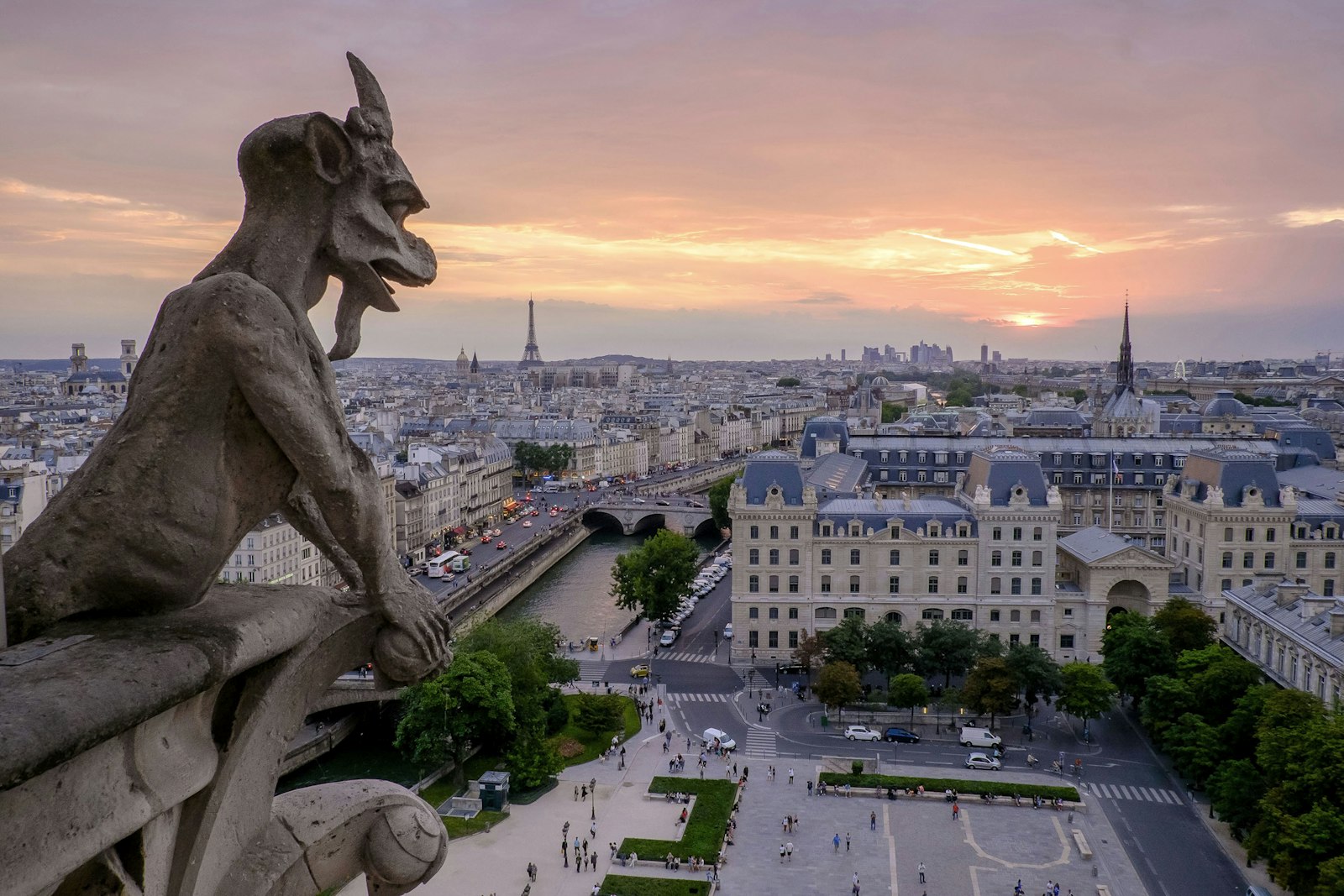
The Roman town of Lutetia grew up on and around this island, and in the Middle Ages it held the king's palace at one end and the cathedral at the other. Work on Notre-Dame began in 1163, and it reopened in December 2024, five years after the fire. Its famous chimeras are younger than most people think: they were added in the nineteenth century.
Saint-Julien-le-Pauvre
Begun around 1165, at the same time as Notre-Dame across the river, on a site that had a church from the sixth century. In the little garden next door grows a black locust planted in 1601, usually called the oldest tree in Paris, and the garden has one of the finest views of Notre-Dame.
Hôtel de Cluny
A late fifteenth-century mansion built for the abbots of Cluny right beside the walls of Roman baths, so you see two thousand years of Paris at a glance. Since 1843 it has been the national museum of the Middle Ages, home of the Lady and the Unicorn tapestries.
Finish: Place Sainte-Geneviève
Saint-Étienne-du-Mont, beside the Panthéon, keeps the tomb of Saint Geneviève, who by tradition turned Attila's army away from Paris in 451. In 1793 her remains were burned on the Place de Grève, where this walk began.
The tour is a walk past these places and does not include going inside the museum or the churches.
What's included
Included
- A local guide who knows the history of the city
- Two hours of stories on the way from the Right Bank to the Left
- Your guide's tips for the rest of your stay in Paris
Not included
- Entry to Notre-Dame, the Cluny museum or the Panthéon
- Food and drinks
- Tips, which are up to you
Where we meet
Métro: Hôtel de Ville (lines 1 and 11)
We meet in the centre of the square in front of the Hôtel de Ville, the city hall. Look for the guide with the red umbrella, and please arrive a few minutes before the start.
This walk does not start at our bike tour meeting point in Grenelle. It finishes on Place Sainte-Geneviève by the Panthéon, in the Latin Quarter.
Good to know
- Online bookings start from two people. Travelling alone? Write to us at hola@tresgatos.es.
- The route works with a wheelchair or a stroller, and dogs are welcome.
- Wear comfortable shoes: there is one gentle climb at the end, up the hill to the Panthéon.
- Online booking closes two hours before the start.
- Want the background first? Read the dark history of medieval Paris in five places.
What guests say
"This was my fourth trip to Paris and I booked it expecting a refresher. Instead I spent two hours in places I had walked past for years without going in. Saint-Julien-le-Pauvre is thirty metres off a street I've eaten on twice, and I had no idea what happened there. If you already know the Paris everyone knows, this is the layer underneath it."
"The history of Notre Dame and the symbolic signs that can be read on the façade of this building is fascinating. It was very interesting and I never thought so much politics and intrigue were hidden on the surface of these walls. A different Paris than "Emily in Paris". I recommend it."
"The tour was absolutely fantastic! We had such a great time, and even our child listened attentively the whole time. Everything was perfect and right on schedule. Highly recommended, we'll definitely be back!"
"My wife and I really enjoyed the tour with Slava! He is a very knowledgeable and engaging guide who will introduce you to the history of the city and give you plenty of useful tips for the rest of your stay. We definitely recommend this tour!"
These are reviews from verified bookings on Viator and Tripadvisor, shortened in places. You can read all of them on Viator.
Questions before you book
Is this tour scary or gory?
No. It's a history walk, not a ghost tour. Your guide tells the true stories behind each place, executions included, in a way that works for adults and curious teenagers alike.
Do we go inside Notre-Dame or the museum?
No. The tour is a walk past the places, with the stories told outside. Entry to Notre-Dame is free if you'd like to go in afterwards, and the Cluny museum and the Panthéon sell their own tickets.
Which time should I choose?
All three walks follow the same route. The 10:00 and 14:00 walks are in daylight. In autumn and winter the 18:00 walk ends after dark, which suits the stories.
Can children join?
Yes. Children aged 4 to 13 pay €25 and children under 4 join free. The route works with a stroller.
What language is the tour in?
English, at every departure.
Is the route accessible?
Yes. The route is suitable for wheelchairs and strollers. There is one gentle climb at the end, up to Place Sainte-Geneviève. Dogs are welcome too.
Can I book on my own?
Online bookings start from two people. If you're travelling alone, write to us at hola@tresgatos.es and we'll see what we can do for your date.
Do you offer private walks or large groups?
Yes. We work with schools, companies and agencies, and just as happily with families and groups of friends. Write to us at hola@tresgatos.es with your date and the size of your group.
Where does the tour start and finish?
It starts on Place de l'Hôtel de Ville, next to Métro Hôtel de Ville, and finishes on Place Sainte-Geneviève by the Panthéon, in the Latin Quarter. It does not start at our bike tour meeting point.
Can I cancel my booking?
Yes. If you cancel up to 24 hours before the tour starts, you get a full refund.