Paris Bike Tour: Eiffel Tower, Notre-Dame and the Louvre with a Local Guide
Three hours on a bike through Paris with a guide who lives here, from the Eiffel Tower along the Seine to Notre-Dame and the Louvre, at an easy pace and with the stories behind each place.
- 3 hoursStarts at 10:15, 13:30 and 16:45
- Free cancellationUp to 24 hours before, full refund
- Guide in English or FrenchChoose when you pick a time
- Small, comfortable groupsPrivate tours also available
- Bike and helmet includedE-bike upgrade for €30
- Easy paceMostly bike lanes and riverside paths
Highlights
- The Eiffel Tower, Les Invalides, Notre-Dame and the Louvre in a single three-hour ride
- A guide who lives in Paris and tells you the history, the stories and the odd local legend behind each stop
- Mostly bike lanes and riverside paths, at an easy pace with plenty of stops
- Photo stops where the views are: the Eiffel Tower, Pont Alexandre III and Notre-Dame
- Before you part, your guide leaves you a short list of places worth your evening
About this tour
Paris is a big city to cover on foot, and the métro shows you very little of it. On a bike it comes together. In three hours we ride from the Eiffel Tower along the Seine to Notre-Dame and the Louvre, mostly on bike lanes and riverside paths, and by the end you have a clear sense of how the city fits together.
Your guide lives in Paris and knows it well. Along the way you'll hear why the tower was never taken down, where every road distance to Paris is measured from, and which details most people walk straight past, along with the lighter stories: local trivia and the odd modern legend.
We keep the pace easy and stop often for photos and questions, which makes this a good way to spend your first day in the city. Before we part, your guide leaves you a short list of places worth your evening and the rest of your stay.
The route
Start: SECCO Grenelle, 75 Bd de Grenelle
Meet your guide, then walk a minute together to pick up the bikes.
Eiffel Tower
Built for the 1889 World's Fair, the tower was supposed to come down after twenty years and survived mostly because it turned out to be a very good radio antenna. Look up at the first level: 72 names of French scientists and engineers are engraved around it, and most people walk straight past them.
Hôtel des Invalides
Louis XIV built it in the 1670s as a home for wounded and elderly soldiers, and it still cares for veterans today. Under the golden dome lies Napoleon, brought back to Paris almost twenty years after his death.
Pont Alexandre III
The first stone was laid in 1896 by Tsar Nicholas II, and the bridge carries his father's name as a sign of friendship between France and Russia. It was kept deliberately low, a single steel arch, so it wouldn't block the view from the Champs-Élysées to the Invalides.
Musée d'Orsay
Before it was a museum, this was a railway station, built for the 1900 World's Fair. Since 1986 it has been home to Monet, Renoir and Van Gogh, and the old station clocks are still in place: from the top floor you can look out over the Seine through one of them.
Sainte-Chapelle
Louis IX built this chapel in the 1240s to keep the Crown of Thorns, and paid more for the relic than for the building itself. From the street you'd hardly notice it behind the walls of the Palais de Justice, but its fifteen stained-glass windows hold more than a thousand scenes from the Bible.
Notre-Dame Cathedral
Work on the cathedral began in 1163, and after the fire of 2019 it reopened in December 2024, its spire rebuilt to the old design. On the square in front, look down for a small bronze star: Point Zéro, the spot all road distances to Paris are measured from.
Hôtel de Ville
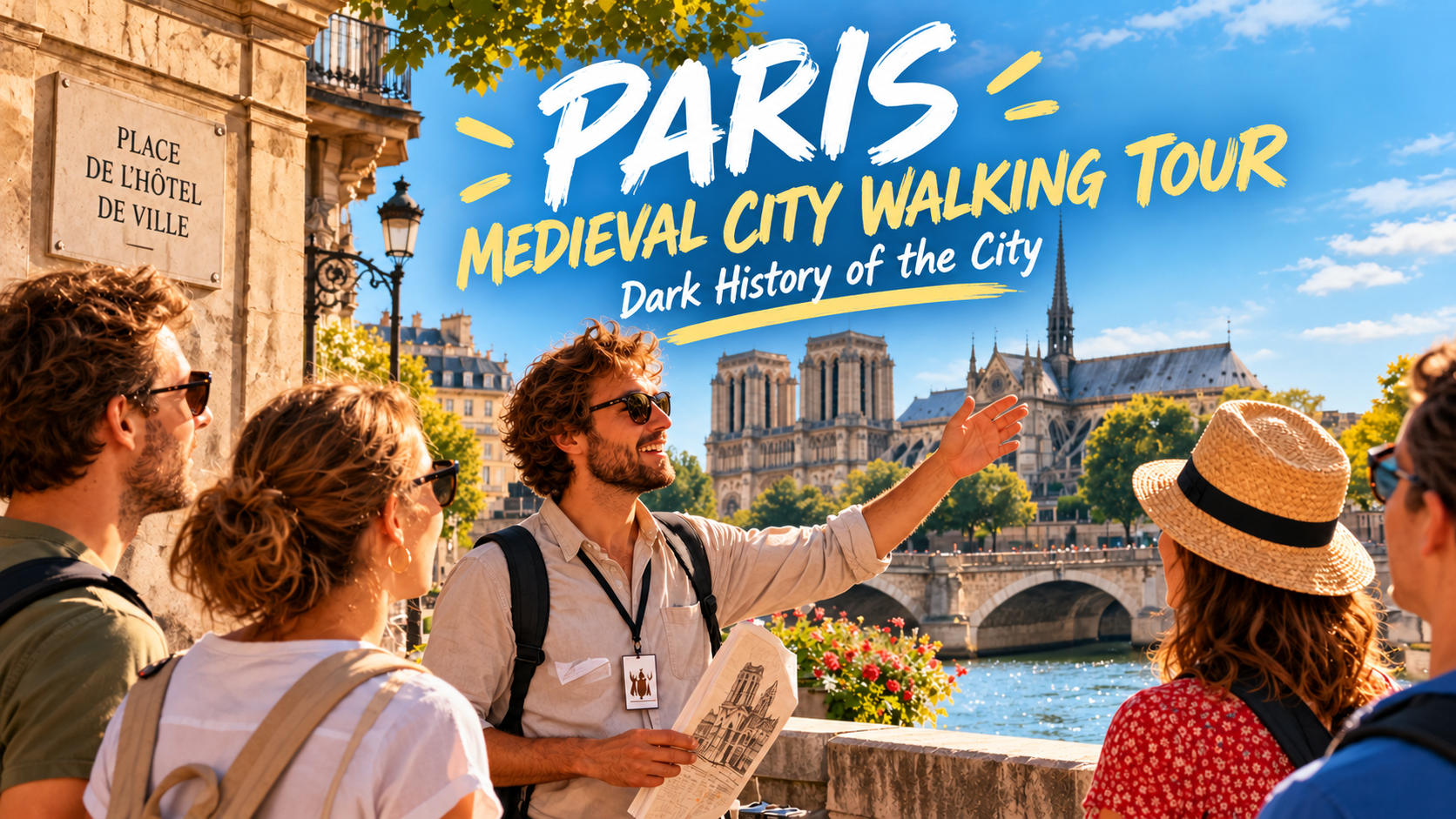
The city has been run from this spot since the 14th century, and today's building replaced the one that burned during the Commune in 1871. The square in front used to be Place de Grève, where men looking for work would gather, and that's why going on strike in French is still "faire grève".
The Louvre
It started around 1190 as a fortress on the edge of the city, became a royal palace, and opened as a museum in 1793. The glass pyramid caused an uproar when it arrived in 1989, and today it's hard to picture the courtyard without it. The walls of the original fortress are still there, down in the basement.
Grand Palais and Petit Palais
Two more buildings left behind by the 1900 World's Fair. The Grand Palais has a glass nave big enough for horse shows, motor salons and, at the 2024 Olympics, fencing. Look up at the corners of its roof for the two bronze chariots, each drawn by four horses.
Finish: 24 Rue Edgar Faure
Back where the bikes came from, a minute's walk from the start.
The order of the stops can change a little with traffic, events and the weather.
What's included
Included
- A local guide who lives in Paris
- Use of a bike for the whole tour
- A helmet, if you'd like one
- Your guide's list of places for the rest of your stay
Not included
- E-bike upgrade, €30 per person
- Entry to the museums and monuments
- Food and drinks
- Tips, which are up to you
Where we meet
Métro: La Motte-Picquet–Grenelle
Your guide will be waiting next to SECCO Grenelle, so feel free to grab a coffee and a croissant while you wait. From there you'll walk a minute together to pick up the bikes. Please don't go into the bike shop on your own: the staff there can't help with the tour.
The tour finishes at 24 Rue Edgar Faure, a minute's walk from where it started.
Good to know
- Everyone except infants needs to be able to ride a bike confidently.
- Adults need to be at least 150 cm tall, and children at least 120 cm.
- After booking, send us the age and height of each child so we can have the right bikes ready.
- E-bikes are for riders aged 14 and over.
- The tour isn't suitable for babies under one year old and isn't wheelchair accessible.
What guests say
"The tour was fantastic. ARS our guide was fun and enthusiastic to show us his town. He had good sized photographs and knew his history. There were only five in the group and he kept us all together. I felt safe on the bike and we went at a good pace. ARS checked on us all along the way. I'm 62 and hubby 60. Thank you ARS for a great adventure."
"Really enjoyable ride through the city. Perfect time of day (4:45pm). Thanks Alex!"
"I absolutely enjoyed this. Alex was so patient with us. Showed us around and explained all the landmarks really well. Highly recommend."
"Alex was a great guide. He spoke very good English and kept us all together. Great way to see the city. Would definitely recommend"
These are recent reviews from verified bookings on GetYourGuide, quoted as written. You can read all of them on GetYourGuide.
Questions before you book
Do I need to be a strong cyclist?
No. You need to ride a bike comfortably, but not fast. We keep an easy pace, ride mostly on bike lanes and riverside paths, and stop often. If you haven't ridden in a while, the e-bike upgrade makes starting off and keeping up easier.
Can children join the tour?
Yes, if they ride confidently and are at least 120 cm tall. Children aged 4 to 13 have their own ticket. After booking, send us each child's age and height so we can have the right bikes ready.
Can I ride an e-bike?
Yes. The e-bike upgrade costs €30 per person and is available for riders aged 14 and over. You can add it when you book.
What language is the tour in?
Our group tours in Paris run in English and in French. You choose the language when you pick a time in the calendar.
Do you offer private tours?
Yes. A private tour gives your group its own guide, and we can adjust the route and the pace to you. Choose the private option in the calendar, or write to us at hola@tresgatos.es for larger groups.
Is entry to the Eiffel Tower or the Louvre included?
No. We stop outside for the views, the photos and the stories, but we don't go in. If you'd like to visit, book a timed ticket for another part of your day.
Where does the tour start and finish?
We meet next to SECCO Grenelle, 75 Bd de Grenelle, near Métro La Motte-Picquet–Grenelle. The tour finishes at 24 Rue Edgar Faure, a minute's walk from the start.
Can I cancel my booking?
Yes. If you cancel up to 24 hours before the tour starts, you get a full refund.